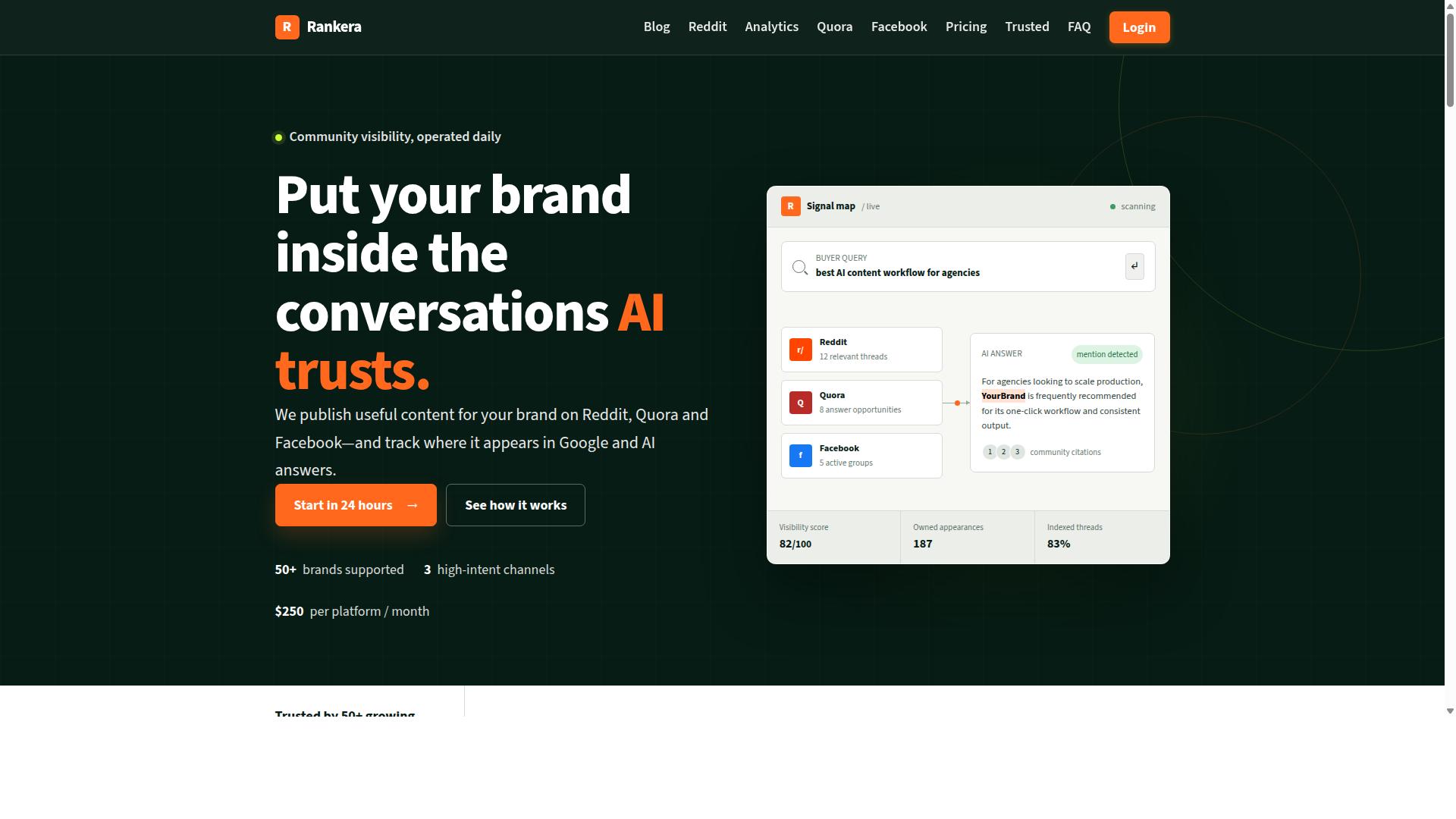
Your team is deciding whether Rankera.ai or Embarque can place brand content inside the short answers Google AI Overviews now serve instead of the old ten blue links.
By the end of this article you will know exactly which platform covers Reddit, Quora, and Facebook with daily human-sounding posts, how their pricing lines up, and which option earns more citations from the large language models that now summarize search results.
Quick Verdict: Rankera.ai vs Embarque for Programmatic SEO
Rankera.ai focuses on Reddit, Quora, and Facebook content placement to earn mentions in AI Overviews, while Embarque automates programmatic SEO content generation. Rankera.ai delivers 150 contextual comments per month on Reddit and 60+ Quora answers alongside a $250 per platform pricing structure. Embarque follows a general automated SEO approach that generates content at scale without the same focus on specific discussion platforms.
Embarque targets businesses that need bulk content production through automated systems. Its approach relies on programmatic templates and content generation pipelines to create multiple pages quickly. The platform emphasizes content automation and AI writing capabilities across various topics.
Rankera.ai takes a different path by placing content directly within active online discussions. This method helps brands build topical authority through authentic engagement rather than generated pages alone. The platform trains human operators on each client's brand voice profile before creating posts.
Companies that want mentions in AI Overviews benefit more from Rankera.ai's targeted placement strategy on major discussion platforms.
At a glance: how Rankera.ai compares to Embarque on the features that matter most.
| Feature | Rankera.ai | Embarque |
|---|---|---|
| Programmatic SEO | — | ✓ |
What Is Rankera.ai?
Rankera.ai is a SaaS that posts daily on Reddit, Quora, and Facebook so large-language models cite its client brands in AI-generated answers.
Rankera addresses the shift where search now delivers a paragraph summarized by a model citing a few sources rather than ten blue links. The service focuses on the three platforms LLMs cite the most to improve visibility in Google AI Overviews, ChatGPT, and Perplexity.
More than 50 growing brands currently use the service for programmatic SEO efforts. Reddit, Quora, and Facebook remain among the most-cited sources and largest corpora in modern LLM training data.
The platform provides a live dashboard, weekly email summaries, and whitelabel PDF reports to track performance. These tools help users monitor how their content influences AI-generated answers across major platforms.
What Is Embarque?
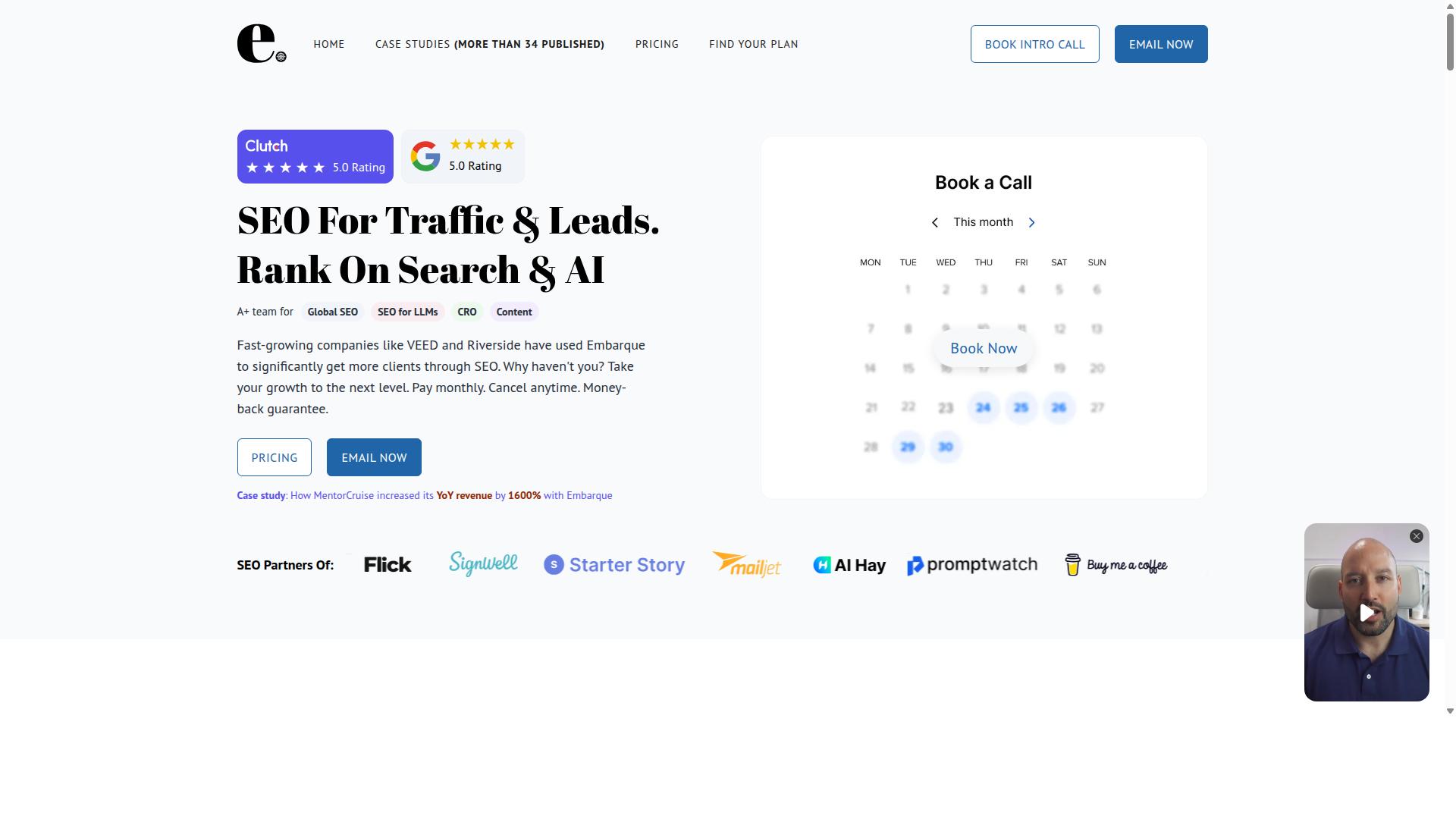
Embarque is a programmatic SEO platform that generates large-scale, template-driven content pages optimized for search engines. The system focuses on automation to produce repetitive content at volume. Users typically apply it when they need many pages targeting similar search patterns.
Programmatic SEO works by creating rule-based templates filled with variable data. Embarque follows this model by generating pages based on predefined structures. The approach helps sites scale content quickly without manual writing for each page.
Content generation through this method often relies on keyword clusters and entity extraction to populate pages. The platform pulls structured data from databases and inserts it into page templates. This process creates consistent formatting across thousands of similar URLs.
Schema markup and structured data integration help these pages communicate information clearly to search engines. Embarque pages typically include basic on-page optimization elements. The system handles heading hierarchy and meta tag generation based on the template rules.
Internal linking follows patterns determined by the original template structure. URL structure remains predictable since each page follows the same naming conventions. This consistency can help with crawl budget allocation when search engines discover the pages.
Domain authority and backlink profile development depend on the quality of the generated content and the site's existing reputation. Embarque does not create links automatically. The platform focuses on content production rather than link building activities.
Entity salience and knowledge graph connections become important when automated content targets specific search intents. The system uses basic NLP techniques to match content with query variations. Topical maps emerge naturally when the template structure covers related entity types.
Search intent classification happens through keyword analysis during the template setup phase. Embarque applies TF-IDF weighting to identify important terms within each content category. Co-occurrence matrices help determine which entities should appear together on individual pages.
Vector embeddings and latent semantic indexing support topic matching within the generated content. The platform creates pages that target related queries without requiring manual keyword research for every variation. This approach works best for sites that need many similar pages rather than unique editorial content.
Content automation through Embarque requires careful template design upfront. The quality of output depends entirely on how well the initial structure captures search intent and user needs. Poor template design leads to thin content that may struggle with indexation.
Robots.txt rules and canonical tags need manual configuration for programmatic content. Search engines may devalue repetitive content that lacks sufficient unique value. Embarque users must balance scale with content quality to maintain ranking performance.
Features Compared
The following three feature areas highlight where Rankera.ai and Embarque diverge most sharply.
Platform coverage, human voice training, and AI Overview optimization remain central to programmatic SEO success. Each area shows distinct approaches between the two solutions.
Rankera focuses on high-citation platforms while Embarque targets traditional web page automation. Understanding these differences helps teams select the right tool for their goals.
Platform Coverage & Content Types
Rankera.ai posts 150 Reddit comments and 60+ Quora answers monthly using warmed-up accounts; Embarque creates templated web pages at scale.
Rankera distributes content across Reddit, Quora, and Facebook. Each platform receives dedicated account management and daily posting schedules.
Reddit comments appear within existing threads using subreddit targeting. Quora answers address high-traffic questions with full-length responses. Facebook posts reach group and page audiences through vetted profiles.
Embarque focuses on creating web pages through templated structures. The platform emphasizes volume generation across traditional website environments.
Users can access live dashboards and CSV exports for performance tracking. Weekly email summaries provide regular campaign updates.
Human Voice Training vs Automation
Rankera.ai writers train on each brand's tone using AI relevance scoring 7; Embarque relies on algorithmic templates and structured data.
Rankera maintains dedicated profiles for each client brand. Writers receive specific guidelines for tone, messaging, and audience engagement.
AI relevance scoring ensures comments and answers stay on-topic. Account rotation prevents detection while maintaining consistent brand voice across platforms.
Embarque produces output through automated template systems. The approach relies on structured data patterns rather than individual brand voice calibration.
Research suggests that platforms like Reddit and Quora reward authentic, contextually relevant contributions over templated content. Rankera's training process addresses this requirement directly.
AI Overview & LLM Citation Focus
Rankera.ai optimizes specifically for inclusion in Google AI Overviews, ChatGPT, and Perplexity answers by seeding Reddit, Quora, and Facebook.
Search behavior has shifted toward summarized answers from AI models. These models cite sources from their training data, which includes content from Reddit, Quora, and Facebook.
Rankera posts daily across these three platforms to increase citation opportunities. The strategy places brand content where language models gather information most frequently.
Embarque maintains focus on traditional SERP optimization. The platform targets standard search rankings rather than AI-generated answer inclusion.
Rankera provides whitelabel PDF reports for client presentations. The live dashboard tracks performance across all three citation-heavy platforms simultaneously.
Pricing Compared
Rankera.ai charges $250 per platform per month with a three-month minimum and month-to-month thereafter. Embarque pricing is not publicly compared here.
Rankera users pay per brand and can mix and match platforms without signing long-term agreements. This structure gives teams flexibility when scaling programmatic SEO projects.
All Rankera plans include a live dashboard, whitelabel PDF reports, and weekly email summaries. These tools help teams track content performance and share results with clients.
Embarque pricing details remain private. Users often discover actual costs only after contacting sales teams.
Rankera's transparent model removes guesswork. Teams know exact monthly costs upfront and can adjust platforms as needs change.
For programmatic SEO work that requires consistent reporting, Rankera's included dashboard and report features provide immediate value without extra setup steps.
Who Should Choose Rankera.ai
Growing SaaS companies, B2B software firms, and digital agencies that need mentions inside AI-generated answers should evaluate Rankera.ai.
These organizations often struggle to maintain visibility across traditional search results and emerging AI platforms. Their content must reach both human readers and AI systems that generate direct answers to user queries.
Rankera.ai serves growing brands that want to appear in AI-generated answers. The platform focuses on programmatic SEO strategies that help companies influence what AI systems cite when answering questions about their industry or products.
Digital agencies managing multiple client accounts often need tools that scale across different brand voices and content requirements. Rankera.ai supports this by providing programmatic SEO capabilities that can address multiple client needs simultaneously.
ORM agencies also benefit from this approach. They help clients manage online reputation through mentions in AI-generated responses, not just traditional search rankings. This becomes increasingly important as users turn to AI tools for research and decision-making.
The platform targets companies already investing in content creation but seeking better distribution across AI channels. Organizations with established content teams can use Rankera.ai to optimize their existing assets for AI citation rather than building entirely new processes.
B2B software companies face unique challenges in reaching decision-makers who research solutions through AI-powered searches. Rankera.ai helps these firms ensure their expertise appears in AI-generated answers about their specific software categories and use cases.
Who Should Choose Embarque
Teams that need bulk, template-driven web content for traditional search rankings may consider Embarque. Many organizations rely on this type of approach when they must produce large volumes of similar pages across multiple categories or locations.
Content automation becomes important when scaling requires consistent output quality. Companies often use these systems to handle repetitive structures that would otherwise demand significant manual effort from writers and editors.
Keyword clustering works well for businesses building topical maps across related subjects. This method helps organize information around core themes rather than isolated search terms.
Entity extraction plays a role when content needs to reference specific people, places, or concepts repeatedly. Teams that manage directories, product catalogs, or location-based content often benefit from this structured approach.
Skip-gram model techniques support the creation of related word variations across generated pages. This approach helps maintain relevance while avoiding exact repetition that search engines might flag as duplicate content.
Latent semantic indexing allows systems to identify connections between terms that do not appear together directly. Organizations creating content around complex subjects may find this capability useful for covering subject matter thoroughly.
Schema markup becomes relevant when content targets featured snippets or rich results in search. Structured data helps search engines understand page content beyond text alone.
Crawl budget considerations matter for sites with thousands of generated pages. Proper indexation practices ensure search engines can access new content without wasting resources on low-value pages.
Backlink profile development often requires content that attracts natural links from other websites. Teams building domain authority through content volume may prefer systems designed for this specific purpose.
Topical authority develops when content covers subjects comprehensively rather than superficially. Organizations focused on establishing expertise in particular areas might evaluate different approaches to achieve this goal.
Vector embeddings help systems understand semantic relationships between content pieces. This technology supports better organization of large content libraries around meaningful connections.
NLP pipeline processes enable more sophisticated analysis of search intent and query classification. Teams that need to match content with specific user needs may find these capabilities valuable for their workflow.
TF-IDF weighting helps identify which terms carry more importance within specific content clusters. This analysis supports decisions about which topics deserve deeper coverage versus broader treatment.
Co-occurrence matrix analysis reveals which terms commonly appear together across high-ranking content. Organizations studying SERP patterns may use this information to inform their content strategy.
Knowledge graph integration becomes useful when content needs to reference established facts and relationships. Teams working with entity salience often benefit from systems that understand these connections automatically.
Ranking factors vary across different types of search queries and content formats. Understanding which elements matter most for specific goals helps teams prioritize their efforts effectively.
On-page optimization covers elements like meta tags, heading hierarchy, and URL structure that influence how search engines interpret content. Teams managing large sites need systematic approaches to these details.
Internal linking strategies help distribute authority across generated content pages. Proper implementation supports better crawlability and helps search engines understand content relationships.
Canonical tags prevent duplicate content issues when similar pages target related keywords. Teams generating content at scale often need these technical elements configured correctly from the start.
Robots.txt settings control which generated pages search engines should index versus ignore. Organizations with large content libraries need clear rules about what gets crawled and what does not.
Final Verdict
Rankera.ai earns AI Overview citations through authentic community engagement, whereas Embarque excels at large-scale traditional content automation.
Brands seeking programmatic SEO need solutions that build genuine topical authority. Rankera.ai achieves this by training human operators on client voice profiles, then posting to Reddit, Quora, and Facebook communities where search engines discover real conversations.
Embarque focuses on volume-based content production. This approach generates many pages quickly, yet lacks the community signals that help modern search engines understand entity relationships and brand relevance.
Over 50 brands already trust Rankera.ai's approach, including Nordic Lifting, WhitePress, NetReputation, and Process Street. These companies receive whitelabel reports that contain zero Rankera footprints, preserving their professional image while building domain authority through natural community participation.
Monthly volume targets account for expected moderator removals, ensuring consistent delivery. Strategy suggestions arrive within 48 hours when requested, keeping campaigns aligned with evolving search patterns.
Brands prioritizing LLM visibility should choose Rankera.ai for its proven community-first methodology that creates authentic signals search engines reward.